The National Committee for Effective Literacy uplifts research, policies, and practices to ensure that English learners/emergent bilinguals leave school as proficient readers and writers in English — and preferably more languages — and who thrive and succeed in school and their communities.
NEW SEARCHABLE RESOURCE LIBRARY
Looking for more information on literacy instruction and the science of reading? NCEL’s new resource library is a curated collection of research and perspectives, with special attention to multilingual learners and biliteracy development.
Search by keyword or filter by topic to explore journal articles, blogs, white papers, and other media. There’s something here for educators, policymakers, researchers, and students, on topics like curriculum, advocacy, and state legislation.
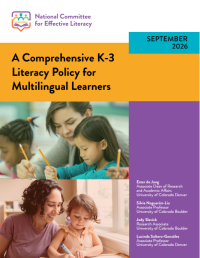
A Comprehensive K-3 Literacy Policy for Multilingual Learners
By Ester de Jong, Silvia Noguerón-Liu, Jody Slavick, and Lucinda Soltero-González
This framework provides states, districts, and communities with research-based guidance for developing, strengthening, and revising literacy legislation and policies to address the specific needs of multilingual learners.
The framework outlines fundamental principles to support a comprehensive, integrated approach to literacy that considers students’ English proficiency, home language development, and prior and current schooling experiences. Reflective questions accompanying each principle help educators, policymakers, and education leaders review and enhance existing literacy policies and legislation to better serve multilingual learners.
For multilingual learners, English literacy development is an enduring challenge as US school systems fail to engage in linguistically and culturally responsive teaching practices and instead fall back on systems and policies designed for fluent and monolingual English speakers. The current movement that promotes specific policies and practices in the name of the “science of reading,” unfortunately, is no exception.
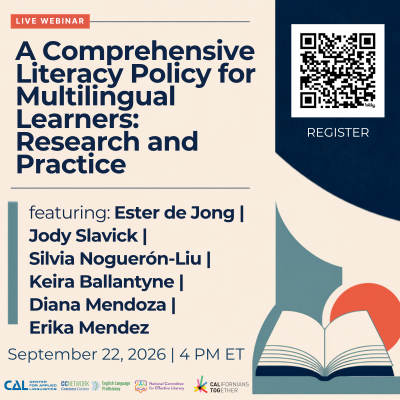
Join us for a webinar looking at a new comprehensive framework for literacy for multilingual learners, followed by examples from practitioners who connect the research on and for multilingual learners to reading reform efforts.
Accessible and Responsive Literacy Instruction: Grade-Specific Recommendations for Multilingual Learners in Illinois
New from the NCEL affiliate, Illinois Committee for Effective Literacy, these recommendations are a companion to the 2024 Illinois Comprehensive Literacy Plan. These recommendations offer linguistically and culturally responsive guidance for educators and school and district leaders in Illinois and throughout the country. The guide provides targeted considerations, strategies, and tools to support multilingual learners who are developing English as a new language in school.
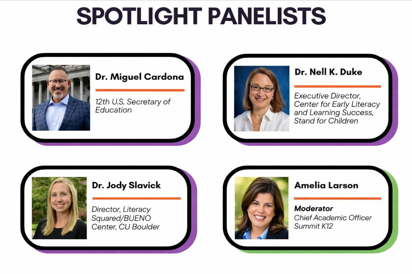
Panel Summary: Designing Literacy and Language Systems for a Multilingual Nation
The closing panel of the inaugural National Committee for Effective Literacy (NCEL) Summit offered a clear message: multilingual learners must be centered in the nation’s literacy systems, not treated as an add-on.
In this article, panel moderator Amelia Larson summarizes the panel conversation among Dr. Miguel Cardona, Dr. Nell K. Duke, and Dr. Jody Slavick. The summary includes a call to action for what educators and system leaders can do to improve literacy instruction for multilingual learners.